


My grandmother kept exactly one dress from her twenties, a navy shirtwaist with a self-fabric belt, and she was buried in a different one because my aunts decided the navy was too worn at the collar to be seen in. I think about that a lot. Nobody keeps a dress for sixty years unless the decade it came from meant something, and the 1950s meant more than most.
The whole thing starts before the decade does, which is awkward for a guide with 1950s in the title, but there it is. February 1947, Christian Dior shows a collection in Paris built around a padded cream jacket and a full black skirt, and an American editor calls it the New Look, and the name sticks. Skirts in that collection ate up twenty yards of fabric. Britain still had clothing coupons. Some politicians called the whole thing offensive, and there are stories of women in fabric-starved towns physically tearing at New Look skirts in the street because the waste made them furious.
Didn’t matter. By 1950 it had won everywhere.
The Silhouette Everything Else Hangs On
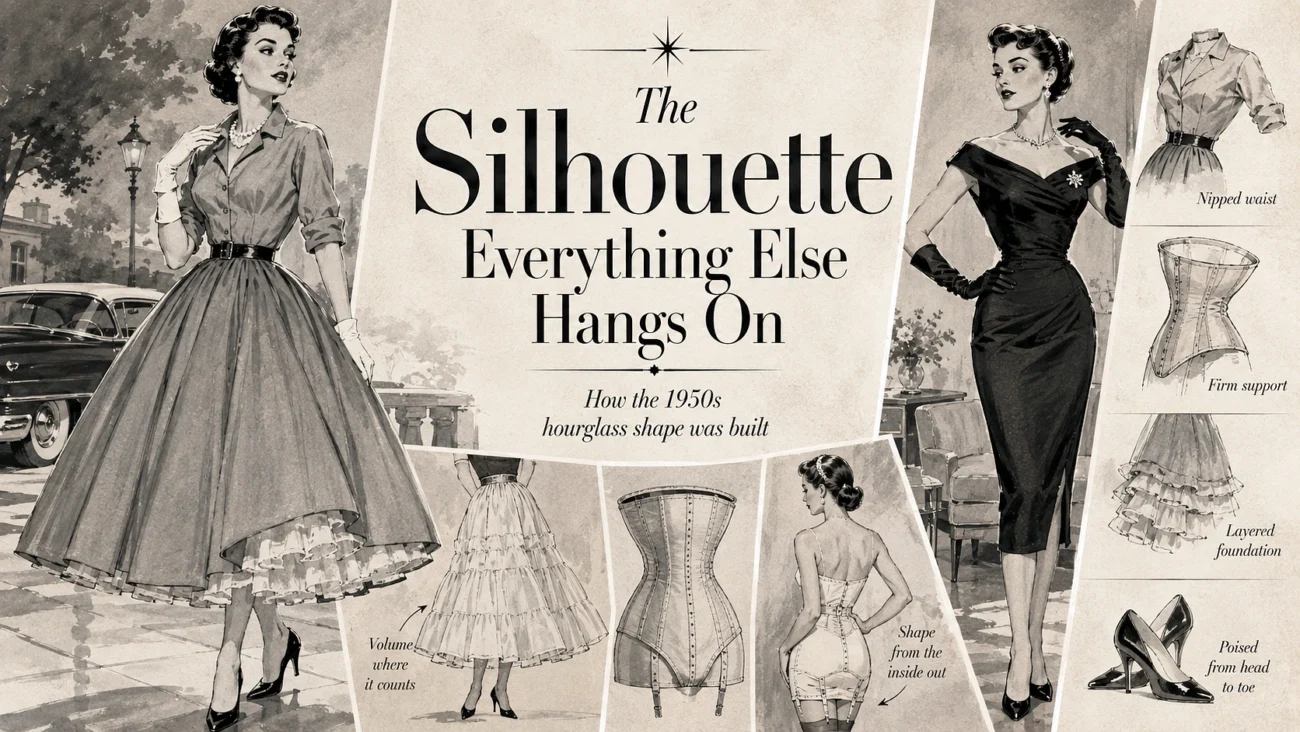
Nipped waist, rounded shoulders, full or narrow skirt to mid calf. The hourglass was the decade’s one non-negotiable, and it was manufactured, not natural. Waspie corsets, boned girdles, stiffened petticoats. If you have ever tried on a reproduction fifties dress and wondered why it looks flat and sad compared to the photos, that is your answer, the underwear was doing half the job and you skipped it.
I hold a mildly unpopular opinion here, which is that the foundation garments are the actual fashion story of the fifties and the dresses are just what got photographed. You can disagree. Every costume department quietly agrees with me.
Key Trends in Women’s Clothing
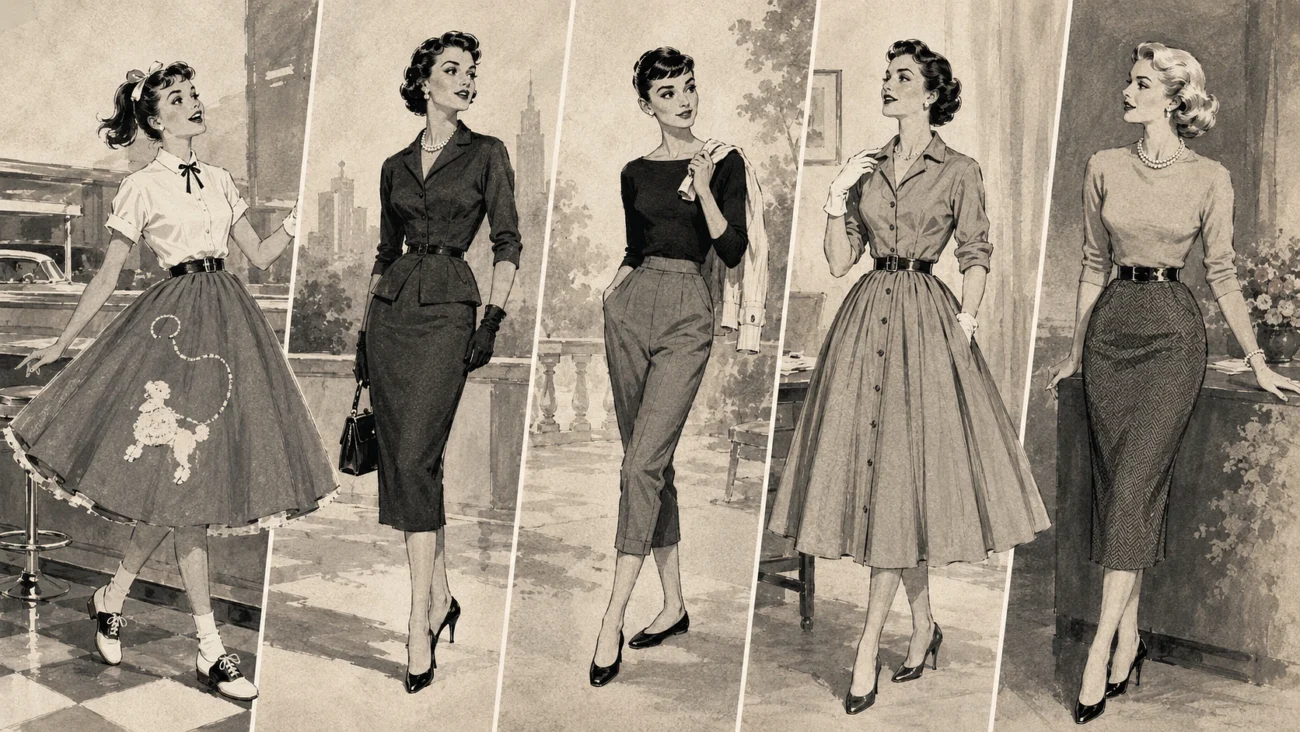
Two silhouettes ran side by side all decade, full and slim, and most women wore both depending on the day.
Circle Skirts and the Poodle Skirt
The poodle skirt exists because a Los Angeles designer named Juli Lynne Charlotte needed a Christmas outfit and couldn’t sew. She cut a full circle from felt, since felt doesn’t fray and needs no seams, glued decorations on, and wore it out. Boutiques asked for more. The dogs came later, then records, flamingos, whatever could be appliquéd. Teenagers wore them with bobby socks and saddle shoes and a blouse tucked in tight.
Honestly, the poodle skirt is a bit overrated as a symbol. It was teenage party wear, not what grown women wore to lunch. But it photographs well, so it became the decade’s mascot.
The Pencil Skirt
The slim answer. Just below the knee, narrow enough to shorten your stride. Dior pushed it in his H-line around the middle of the decade, though Balenciaga had been arguing for leaner sculptural shapes the whole time and fashion people will tell you, at length, that Balenciaga was the real genius of the period. Office wear, cocktail wear, Marilyn Monroe wear, depending on how tight.
Capri Pants
Trousers were still slightly scandalous on women, and they got in through the side door marked leisure. Sonja de Lennart gets credit for the capri itself. Audrey Hepburn in slim black trousers and flats did more for the style than every magazine combined. Meanwhile the American designer Claire McCardell was building an entire wardrobe philosophy around clothes women could move in, cotton separates, wrap dresses, ballet flats, and if you want to know where American casual dressing actually comes from, it’s her, not Paris.
The Shirtwaist Dress
Button front, collar, belt, full skirt. My grandmother’s navy one. The absolute workhorse of the decade, in every catalogue, on every sitcom wife. Nothing more needs saying about it, which is sort of the point of it.
Sweaters
Tight knits over cone-shaped bullet bras created what the press called the sweater girl, Lana Turner first, Jayne Mansfield loudest. School boards hated it all decade and never won.
The two silhouettes, roughly:
| Full skirt | Slim skirt | |
|---|---|---|
| Underneath | Net petticoats, layered | Girdle |
| Feel | Young, casual, dance floor | Adult, city, evening |
| Screen version | Grace Kelly, Rear Window | Monroe, Niagara |
Men, Briefly, and Then the Teenagers Who Broke It
The adult male uniform was the grey flannel suit, so universal it became a novel and then a Gregory Peck film. Narrow lapel, thin tie, fedora. Weekends meant cardigans or, bravely, a Hawaiian shirt.
The interesting part is what happened underneath that consensus. Brando in The Wild One, then James Dean in Rebel Without a Cause, put a white T-shirt, jeans, and a jacket on screen and suddenly denim, which had been miner’s cloth, meant something. Some American schools banned jeans outright because everyone understood exactly what they now said. Over in Britain the Teddy Boys got to the same rebellion from the opposite direction, long Edwardian drape jackets, drainpipe trousers, enormous quiffs. Same message, better tailoring.
The Icons
Four women, four different corners of the decade, and usefully they barely overlap.
- Grace Kelly was the patrician one. Edith Head dressed her for Rear Window, and her wedding gown for the Monaco marriage, built by MGM’s Helen Rose from something like twenty-five yards of taffeta plus antique lace, is still the dress royal brides get compared to. The Middleton dress owed it plenty and everyone said so at the time.
- Audrey Hepburn proved you could refuse the hourglass completely. Her Givenchy partnership started on Sabrina, and the boat neck, cropped trouser, flat shoe formula she settled on is probably the single most copied personal uniform in fashion history.
- Marilyn Monroe needs one sentence and a number. The white halter dress from The Seven Year Itch sold at auction decades later for $4.6 million.
- Brigitte Bardot was the French correction to all that American polish, gingham, bare shoulders, hair deliberately undone, and a bikini at Cannes while US swimwear was still resolutely one-piece.
And Chanel. In 1954, at seventy-one, she came out of retirement, looked at all the corsetry Dior had brought back, and answered with a boxy collarless tweed suit a woman could breathe in. Reviews were cool. Women bought it for the next half century, which is the only review that counts.
Evening Wear
Evening was where the decade showed off. Strapless boned bodices, ballerina-length tulle for the young, floor-length satin for the formal, and the full accessory kit worn without irony, opera gloves past the elbow, a fur stole, pearls. The cocktail dress as a named category is basically a fifties invention, and Dior pushed the term hard because a new category meant a new thing to sell.
None of it pretended to be effortless. That came later, and frankly effortlessness has been fashion’s least honest word ever since.
Hair and Makeup
Set, style evolution. Pin curls, the poodle cut, the short Italian crop. All of it sprayed into architecture.
Makeup ran one formula the entire decade with total confidence: matte pale skin, arched brows, winged black liner, red lips. Revlon’s Fire and Ice campaign sold that red harder than anyone. If you only take one thing from this whole guide into your own mirror, take the liner-plus-red-lip combination, it does more fifties work than any garment and costs the least.
Wearing It Now
Practical bits, since most people reading this are dressing for something, not writing a thesis.
- Buy the petticoat. A full-skirted dress with nothing under it is just a midi dress. Decent petticoats run under $40.
- Pick one silhouette per outfit. Pencil skirt with saddle shoes confuses both.
- True vintage runs small, roughly two to three modern sizes off, a labelled 12 from then is around a modern 6. Shop by measurements only.
- Check hem length on reproductions. Mid calf is period. Knee length is what costume shops do to save fabric.
- For men, dark slim jeans, white tee, leather jacket. That’s the whole Dean reference and it reads as ordinary clothes, which is exactly why it works.