

She walks into a room and something shifts. She’s not the loudest one there. She’s not trying. But people turn, conversations pause, and there’s just — something. You can’t name it, and that’s the whole point.
That quality has a name. Several, actually. Presence. Magnetism. Glow. All of them point at the same thing — a woman whose energy carries her further than her appearance ever could.
Science actually backs this up.
Where This Energy Comes From, According to Research
A 2010 meta-analysis in the Journal of Applied Psychology found women score consistently higher than men on emotional intelligence ability — roughly half a standard deviation across studies. Separate PMC research on emotion perception found women read subtle emotional cues more accurately and at greater speed.
What that means practically: women are, on average, wired with stronger social attunement than culture gives them credit for.
The problem isn’t that the ability isn’t there. It’s that most women never use it deliberately. It stays buried under performance anxiety, people-pleasing, or the constant pressure to be smaller.
Real glow isn’t manufactured. It’s what happens when you stop suppressing what’s already there.
Why Radiating Feels Effortless and Performing Feels Exhausting
This is where most people get confused.
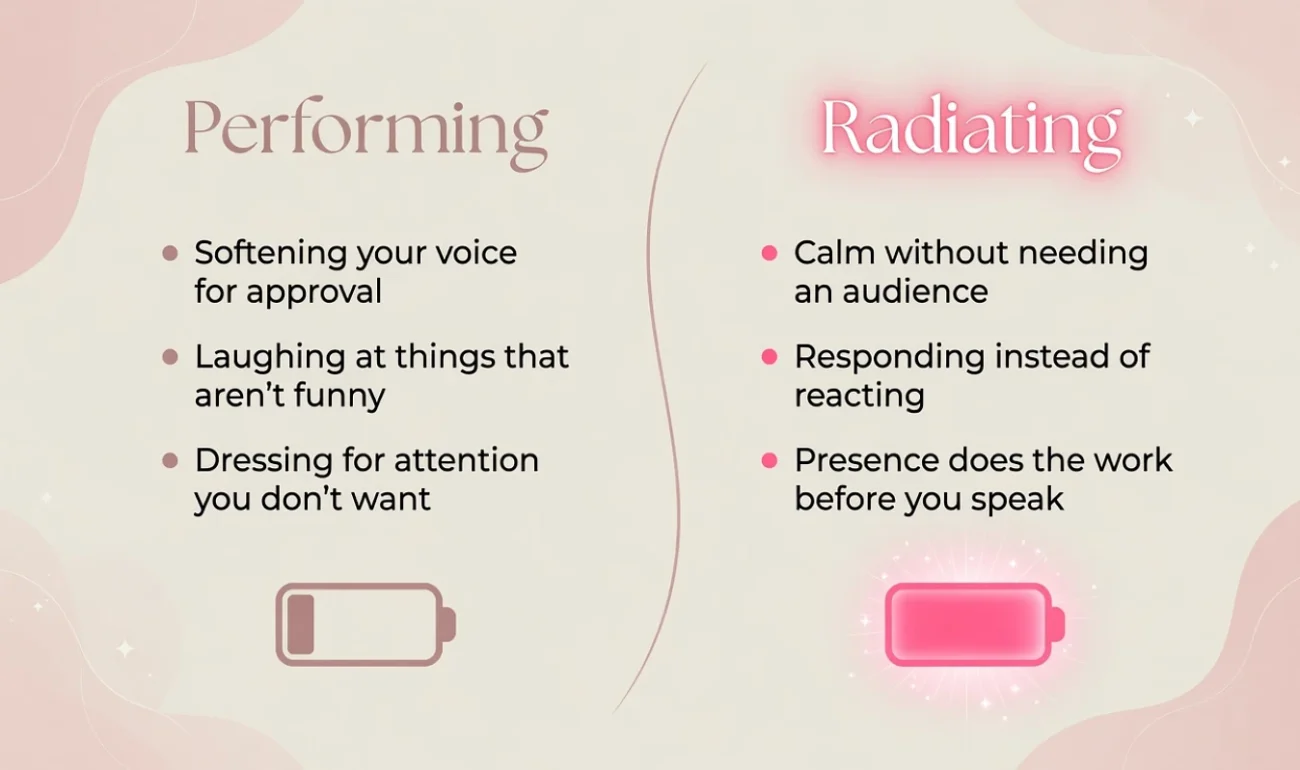
Performing femininity looks like softening your voice for approval, laughing at things that aren’t funny, or dressing for attention you don’t actually want. It’s work. And people feel it — that faint static of someone not quite being real.
Radiating is different. It’s calmer. It doesn’t need an audience.
Behavioral psychology research consistently shows the most magnetic people in any room aren’t the ones demanding space — they’re the ones who don’t need to. They observe before speaking. They respond instead of react. Their presence does the work before they open their mouth.
Acadia Psychotherapy’s research flags something worth saying plainly: when this energy gets misread as compliance, women absorb disproportionate emotional labor. That leads straight to burnout. The glow fades fast when you’re running on empty trying to be soft for everyone.
Feminine energy isn’t a service you provide. It’s a state you maintain — for yourself first.
Three Women Who Built Their Glow From the Inside Out
Sabrina Carpenter: She Stopped Adjusting Herself for the Room
For years, Sabrina Carpenter was talented and known. Disney Channel, a solid career — but not iconic. Not yet.
Then something shifted. She didn’t reinvent herself. She leaned in — completely, without apology — to exactly who she already was. The vintage-inspired aesthetic, the unapologetic femininity, the confidence that registers before you even process what she’s wearing.
She said it herself to WhoWhatWear: “I want to feel as confident as humanly possible so I can be up there and not worry about what I’m doing.” The clothes were an extension of a feeling she’d already built internally. Not the other way around.
She became the defining It Girl of 2024 not because she changed — because she stopped needing confirmation that who she already was was enough.
Beyoncé: She Chose Freedom Over Perfectionism and the Room Felt It
Beyoncé spent years being one of the most technically perfect performers alive. Controlled. Disciplined. Flawless.
Then came Renaissance. She described making it as a deliberate choice to be “free of perfectionism and overthinking — a place to scream, release, feel freedom.” Not a rebrand. A release.
The difference was felt immediately. NPR noted the Beyoncé of Renaissance was “more carefree than ever.” On the track “I’m That Girl” she declared her radiance without needing external proof — “it’s not the diamonds, it’s not the pearls… it’s just that I’m that girl.” Confidence so settled it didn’t require justification.
That’s the energy. Not loudness. Not perfection. Rootedness.
Jennifer Lopez: She Held Her Ground When the Industry Told Her to Shrink
Early in her career, Hollywood told J.Lo to lose weight. Repeatedly.
Her response, years later in InStyle: “It finally got to the point that I was like, ‘This is who I am. I’m shaped like this.’ Everybody I grew up with looked like that, and they were all beautiful to me.” She told W magazine: “I just appreciate myself in a way I didn’t when I was younger. And it’s not about perfection. I like the scars that I have.”
She told the same publication something that holds up: “Men in their 20s are very confident and cocky, and women are super-insecure. And then it flips — men get insecure, and women get comfortable in their own skin, in a way that makes them more beautiful.”
At her 2026 Las Vegas residency, critics came for her age. Her response onstage was composed, direct, and delivered with humor — not defensiveness. That composure under pressure? That’s not a talent. That’s a practice built over decades.
What the Women Who Carry This Energy Have in Common
Strip away the aesthetic language and here’s what’s underneath: femininity is tied to inner character far more than outward presentation.
The women people remember tend to share a few things.
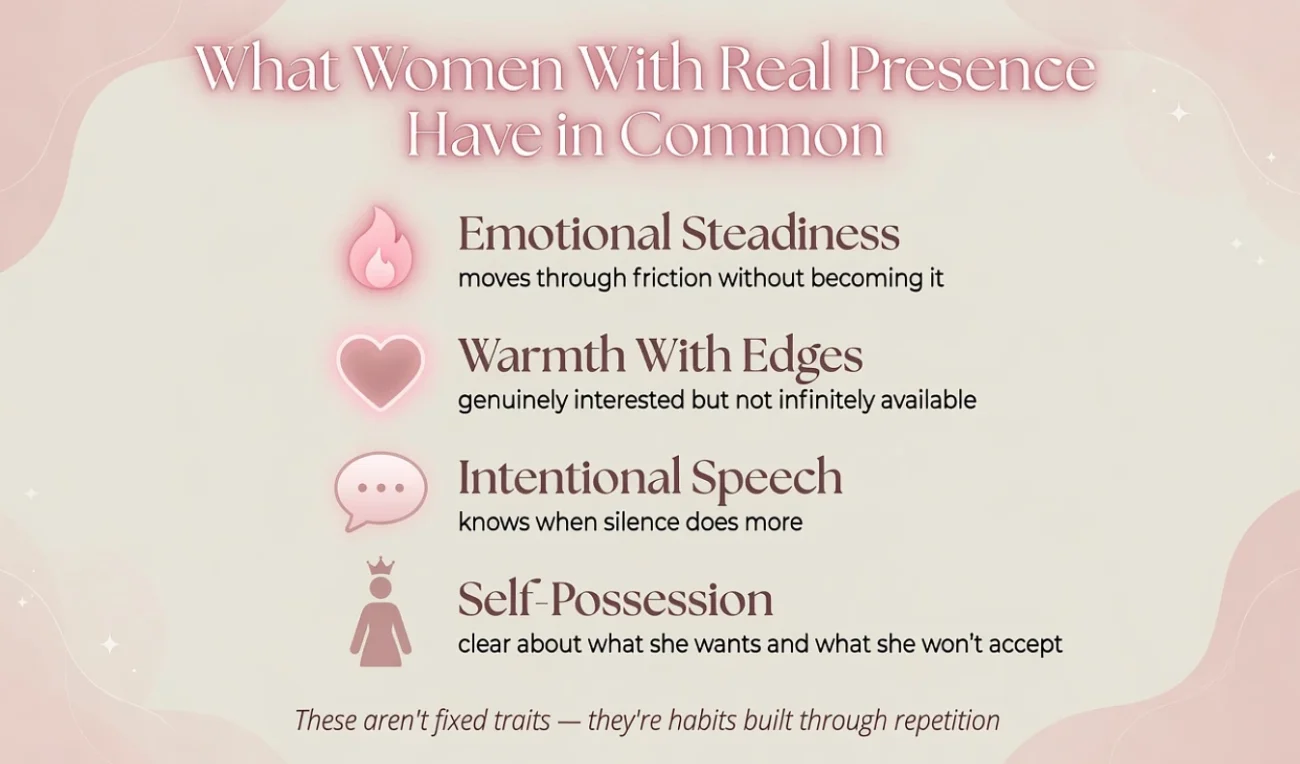
Emotional steadiness. They don’t mirror the chaos around them. They move through friction without becoming it.
Warmth with edges. Genuinely interested in people — but not infinitely available to everyone. That distinction lands differently than most women realize.
Intentional speech. Not quiet — intentional. They know when to say something and when silence does more.
Self-possession. Clear about what they want, clear about what they won’t accept, and they don’t need to announce either.
None of these are fixed personality traits. They’re habits. Built slowly, through attention and repetition.
How This Energy Changes the Way You Show Up in Relationships
This is where the research gets interesting.
A PMC study on female leadership found emotional intelligence is a core mechanism in why women consistently rate higher in transformational leadership — the kind that inspires rather than directs. Women who score higher in emotional attunement create environments where people feel seen without being managed.
That quality carries directly into personal life. Feminine behavior in relationships shows up not as compliance — but as clarity. Communicating without aggression. Receiving care without suspicion. Holding standards without turning every interaction into a test.
The women in the room who have that energy? They’re also usually the ones people want to be around. Not because they’re performing warmth — because they actually have it.
What Getting Dressed Has and Hasn’t Got to Do With It
New dress, great lighting, a blowout — those things genuinely help. Feeling good in what you wear does affect how you carry yourself, and that’s not trivial.
But the women with that real, room-shifting presence? They’ve done internal work that shows up before anyone registers the outfit.
Slowing down reactions. Choosing responses over impulses. Knowing their worth well enough that they’re not quietly auditioning for it in every conversation.
The glow is what’s left when you stop performing.
Three Habits That Actually Build This Over Time
Not a transformation checklist. Just three honest ones.
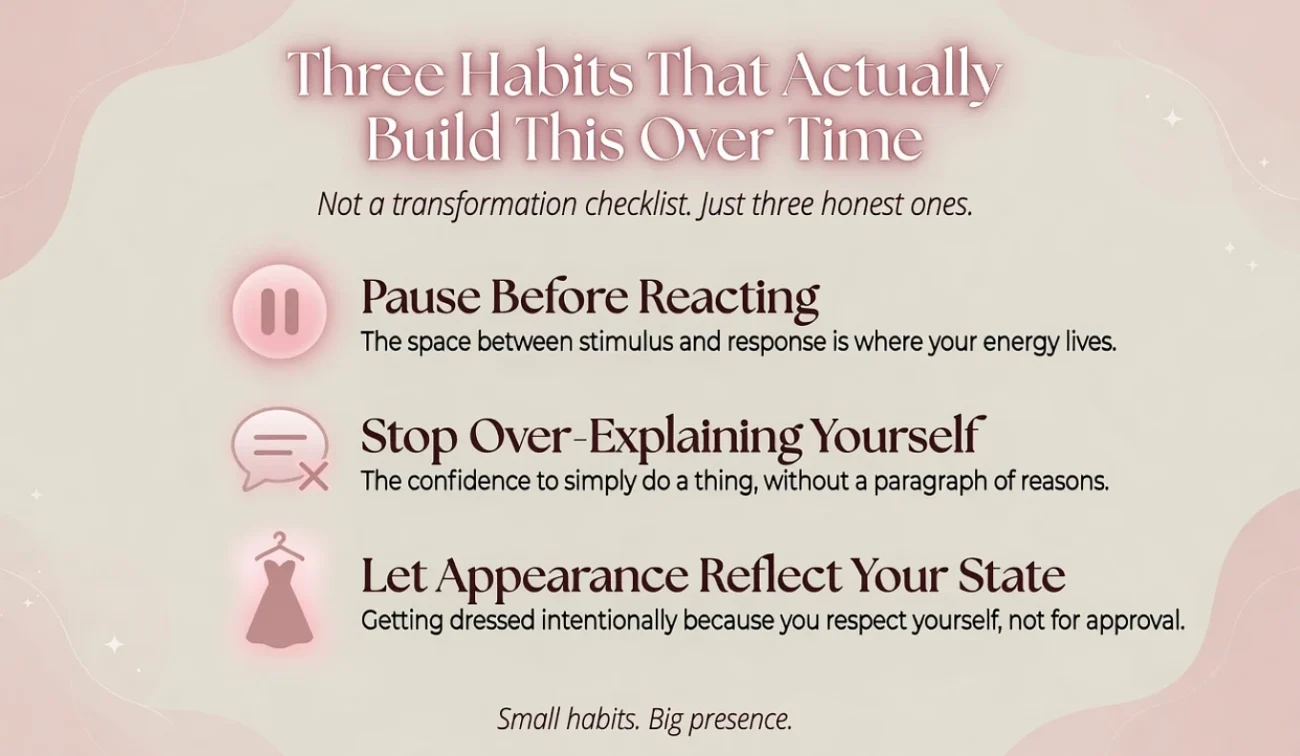
- Pause before reacting. The space between something happening and your response is where the whole energy lives. A woman who doesn’t mirror every irritation around her reads as grounded in a way that’s genuinely magnetic.
- Stop over-explaining yourself. Justifying everything you do is a form of anxiety most women don’t even notice. The confidence to simply do a thing, without a paragraph of reasons, changes how people receive you.
- Let appearance reflect your state — not create it. Getting dressed intentionally, not for attention but because you respect yourself enough to show up well, lands differently than dressing for approval. People feel the difference even when they can’t name it.
The woman in that room — the one the energy belongs to?
She didn’t stumble into it. She built it. Quietly, imperfectly, over time. And that’s the part that makes it real.
This article is for informational purposes only.