

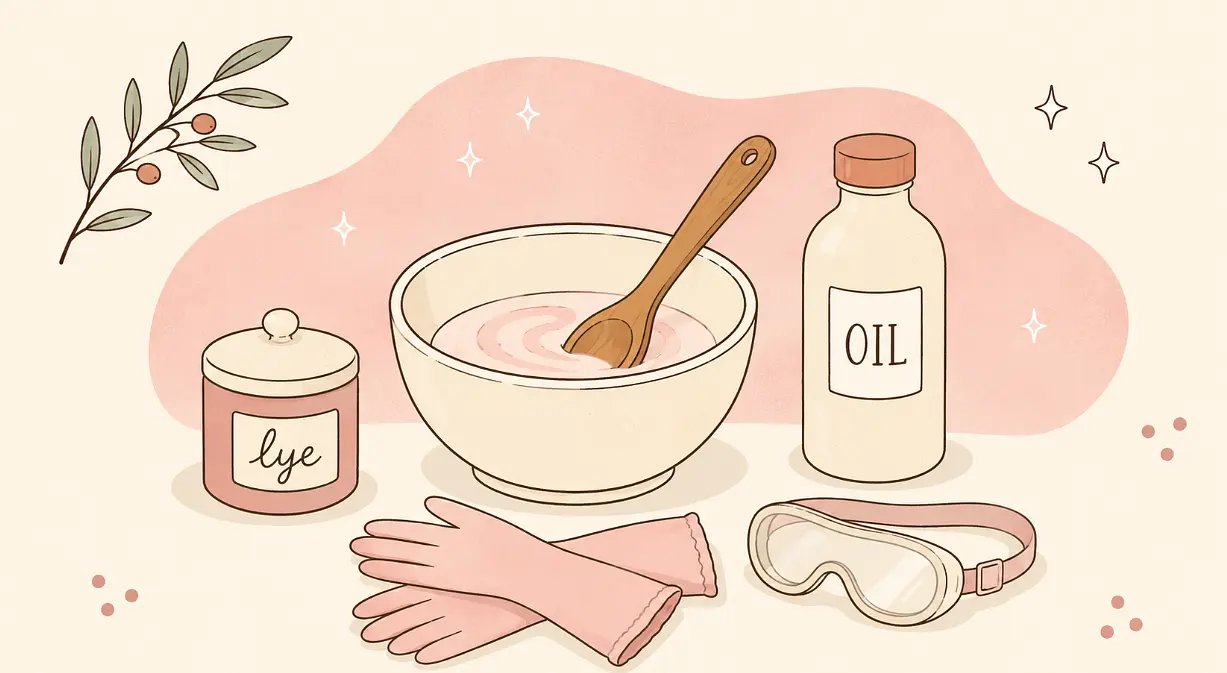
The bar sitting by your kitchen sink was made with lye. So was the oat milk one from the farmers market, the goat milk one your aunt swears by, and every honest bar of soap going back to whoever first noticed that ash water and grease do something interesting together.
None of that lye is in the bar anymore. That’s the part the scary-ingredient posts always skip, and it’s the whole reason you can relax about it.
Fat goes in, lye goes in, soap comes out, and neither survives
Soap isn’t fat with lye added. It’s what fat and lye turn into when they meet.
You take oils, olive, coconut, even saved bacon grease if you’re going old-school about it, and you mix them with lye dissolved in water. The two start reacting on contact, and over the next day or so the whole batch transforms into something new, which is soap plus a little natural glycerin. The lye gets used up in the making. The oils get used up too.
Think of it the way you’d think about cake. Raw eggs and flour go into the bowl, and what comes out of the oven contains neither raw egg nor loose flour, because baking turned them into cake. You’d never worry about salmonella from a slice of baked cake. A cured bar of soap has the same relationship to lye. It was an ingredient of the process, and the process ate it.
Soap makers even stack the deck on purpose. Most recipes run extra oil beyond what the lye can react with, a few percent of cushion, so the lye runs out first with complete certainty and the leftover oil makes the bar gentler. The craft has been solving this problem for a very long time.
So what are the lye-free labels selling?
Mostly a bar that somebody else made with lye.
Melt-and-pour soap base, the kind crafters melt down and pour into cute molds with lavender buds on top, arrived at the craft store already saponified. The lye step happened at a factory before anyone stamped lye-free on anything. The crafter never touches the stuff, which is honestly a fine way to make pretty soap, but the claim on the label is about their kitchen, and about the chemistry.
The other things sold as soap without lye usually aren’t soap at all. Plenty of body bars in the drugstore are synthetic detergent bars, which clean fine and skip the lye by skipping soap entirely. Different product, different label rules.
There’s nothing wrong with any of these. Just know that if it lathers and it’s real soap, lye was there at the start.
What making a batch at home actually looks like
Once you know the lye vanishes into the reaction, the next thought for a lot of people is that they could do this themselves. And they can. Cold process soap is a kitchen-scale hobby with a big, friendly community around it, and a basic batch needs a stick blender, a kitchen scale, a mold, some oils, and lye.
The short version of a batch: you weigh your oils, you weigh your lye and water, you combine the lye with the water, you wait for that mixture to cool, you blend it into the warmed oils until the whole thing thickens to about pudding, you pour it in the mold, and then you leave it alone. A day or two to harden, then four to six weeks on a shelf while the last of the reaction finishes and the water evaporates out. The waiting is genuinely the hard part.
Every step of that is beginner-friendly except one.
The dangerous ten minutes
Mixing the lye and water is where this hobby earns its safety rules, and it deserves plain talk.
Dry lye hitting water releases a lot of heat, fast. The mixture can jump near boiling in seconds, it puts off fumes you should not lean over and breathe, and a splash of it will burn skin in a way an oven burn doesn’t. Every experienced soap maker treats this step with the same respect, and the rules they follow aren’t complicated:
- Lye goes into the water. Never water onto lye. Pouring water onto dry lye can make it spit and erupt, and this rule matters enough that soap makers turn it into little rhymes to remember it.
- Do it in a ventilated spot, near an open window or outside, and keep your face out of the rising fumes.
- Gloves and real eye protection on before the container opens. A splash in the eye is an emergency, full stop.
- Heatproof, lye-safe containers only. Sturdy plastic marked PP5 or stainless steel. Never aluminum, which reacts with lye, and never a random glass jar, which the heat can crack.
- No kids, no pets, no distractions in the room while it’s happening.
- Vinegar handy is an old habit for skin contact, but the real answer for any serious contact is lots of running water and, for eyes or anything beyond a minor splash, medical help.
Some people look at that list and decide the trade is worth it, and it usually is, since the step takes ten careful minutes. Others would rather skip it entirely, and there’s a legitimate shortcut: buying a ready-made caustic soda solution means the dissolving already happened under controlled conditions, so the hottest, splashiest moment of the whole hobby never happens on your counter. You still handle it with the same gloves-and-goggles respect, because it’s still lye, but the violent part is done.
Buying it like an adult
The other place beginners go wrong is the sourcing, because the internet is full of advice to just grab crystal drain opener from the hardware store.
Don’t. Drain products are often not pure sodium hydroxide, and the additives that help them eat a hair clog have no business in something that ends up on your skin. Soap needs clean, known-purity lye with real documentation behind it.
That means buying from an actual chemical supplier. A proper one, like Distripark.eu, lists the concentration and purity, ships it labeled correctly, and provides the safety data sheet, which is the boring document that tells you exactly what you’re holding and what to do if something goes wrong. Hobby quantities follow the same storage sense as industrial ones: original container, tightly closed, labeled, dry spot, up high away from kids and pets, and never, ever decanted into a drink bottle. People have been hurt by exactly that mix-up, and it’s the most preventable accident in the whole hobby.
One boundary worth stating while we’re here. Sodium hydroxide is also the active ingredient in traditional hair relaxers, and that is a salon-formulated, salon-applied product. Industrial lye never goes near hair or skin as a treatment, no matter what a video claims.
After that, the hobby is mostly patience. The bars sit on their rack, sweating out water week by week, getting harder and milder, and somewhere around week five you hand one to somebody and mention, casually, that you made it, lye and all.