

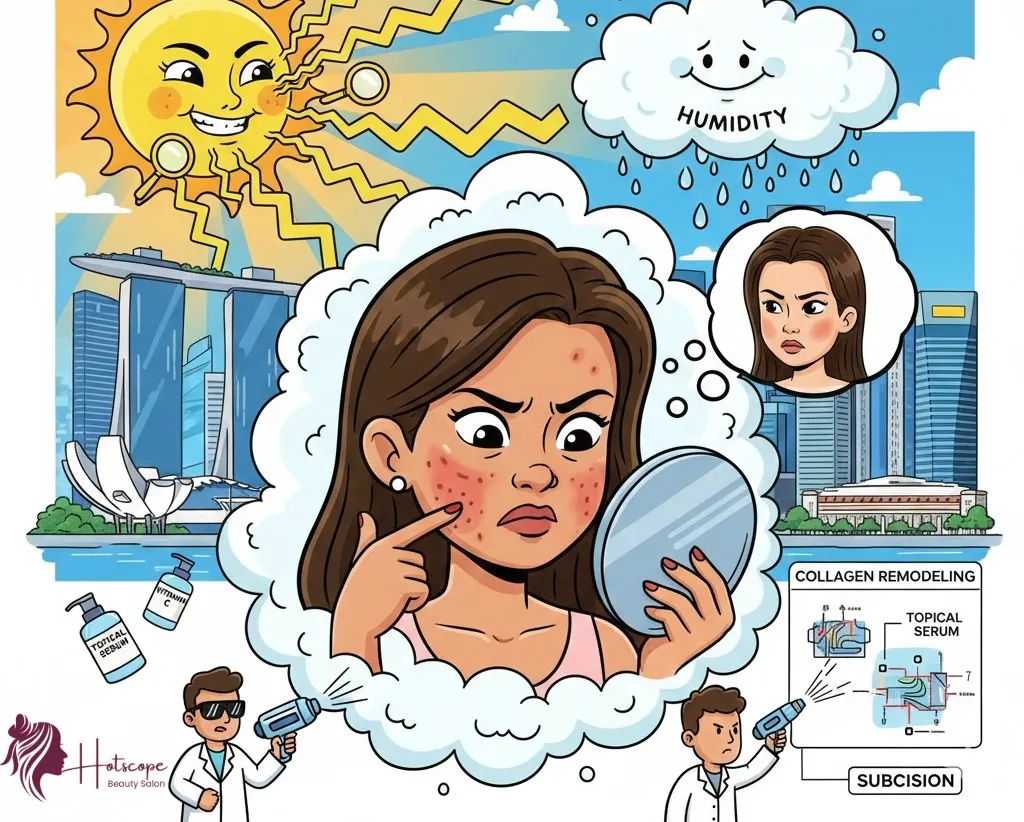
Acne clears up, but the marks stick around. If you’ve spent months staring at dark spots and uneven texture wondering why nothing seems to work, Singapore’s climate isn’t doing you any favours.
The problem is twofold. Humidity here hovers between 82% and 87% year-round, which keeps skin perpetually congested and slow to heal. Then there’s the UV situation – Singapore’s UV index regularly hits 12-15 during peak hours, and even on cloudy days it rarely drops below 6. That’s classified as “high” to “extreme” exposure by WHO standards. For skin trying to recover from inflammation, this is basically a setup for failure.
Post-inflammatory hyperpigmentation – those flat brown or red marks left behind after breakouts – gets worse with UV exposure. The melanocytes that produce pigment stay on high alert when UV radiation is constantly triggering them. A 2024 systematic review published in the Journal of Cutaneous Medicine and Surgery confirmed what dermatologists in tropical climates have observed for years: PIH is frequently exacerbated by ultraviolet radiation and excess sun exposure, and tends to be more prominent and enduring in individuals with darker skin tones (Fitzpatrick skin types III-VI).
So that “wait and see” advice? It doesn’t translate well here.
The Difference Between Marks and Actual Scars
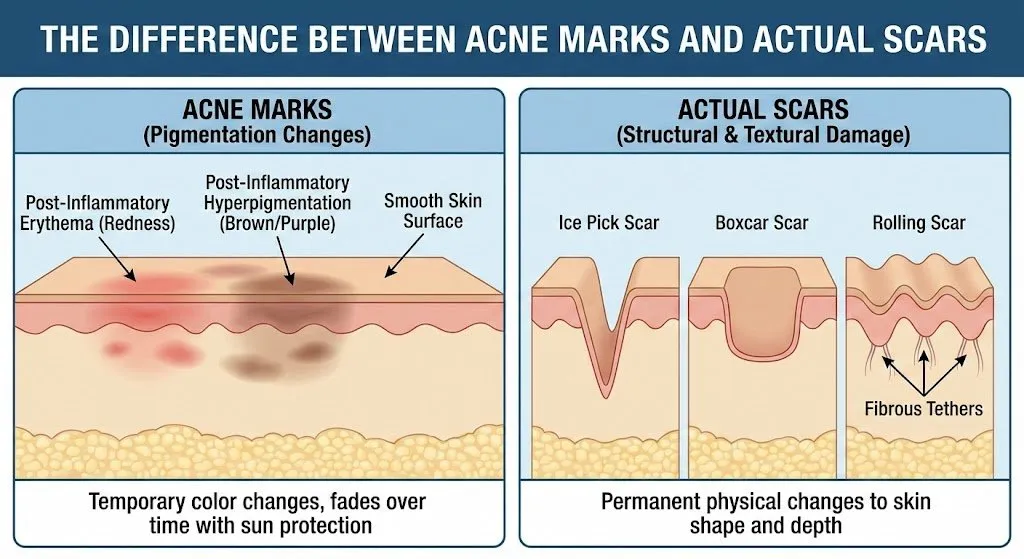
Most people use “acne scars” to describe everything their breakouts left behind, but there’s a meaningful distinction.
Marks are colour changes – red, purple, brown – on otherwise smooth skin. These are pigmentation issues, and they do eventually fade. In Singapore’s climate, “eventually” can mean a year or more if you’re not aggressive about sun protection.
Scars are structural. The skin has physically changed shape. Ice pick scars are narrow and deep, like someone poked the skin with a sharp object. Boxcar scars are wider with defined edges. Rolling scars create that undulating, shadowy appearance because fibrous bands are literally pulling the surface skin downward.
People seeking acne scarring treatment Singapore clinics often have a combination of both – pigmentation issues layered on top of actual textural damage. Treating one without addressing the other leads to the frustration of “I did the treatment but my skin still doesn’t look right.”
Why Topicals Have Limits
Vitamin C serums, retinoids, niacinamide – these all have their place. They can accelerate pigment fading and improve overall skin quality. But they operate at the surface level. If your scar exists because collagen was destroyed during deep inflammation, or because fibrous tissue is tethering your skin down, no serum penetrates far enough to fix that.
This is where the 10-step skincare routine crowd gets stuck. They’ll cycle through every brightening ingredient on the market, see some improvement in surface tone, and still have shadows and texture issues that won’t budge.
The structure needs rebuilding. And rebuilding requires a different approach entirely.
What Collagen Remodelling Actually Means
When clinicians talk about “stimulating collagen,” they’re describing a controlled injury-healing response. You create precise damage, the body responds with repair mechanisms, and if done correctly, the new tissue that forms is better organised than the scar tissue it’s replacing.
Fractional CO2 lasers work this way – they create microscopic columns of thermal injury in the skin, leaving surrounding tissue intact to speed healing. A split-face study published in PMC compared fractional CO2 laser to microneedling and found the laser achieved 32.9% improvement in scar grading versus 9.3% for microneedling. The difference was statistically significant, particularly for severe scarring.
But there’s a catch for Singapore patients. Fractional lasers carry a higher risk of post-inflammatory hyperpigmentation in darker skin types. The same study noted PIH was greater in patients with darker skin and occurred in 30% of laser-treated sides. In a tropical climate with constant UV exposure, this risk multiplies.
This doesn’t mean lasers are off the table – it means the approach needs calibration. Lower energy settings, longer intervals between sessions, strict sun protection protocols, and sometimes pre-treatment with tyrosinase inhibitors to calm melanocyte activity before the procedure.
The Problem With Tethered Scars
Rolling scars present a specific challenge that surface treatments can’t solve. The issue isn’t just missing collagen at the surface – it’s that fibrous bands have formed underneath, anchoring the skin to deeper tissue. The scar is literally being pulled down.
No amount of laser resurfacing or topical treatment reaches those bands. They need to be physically released.
Subcision addresses this directly. A needle or cannula is inserted beneath the scar and moved in a fanning motion to sever the fibrotic strands. The controlled trauma also triggers new collagen deposition in the space created. The technique was first described by Orentreich and Orentreich in 1995 and has remained a core treatment for rolling and bound-down scars ever since.
A 2022 study in Lasers in Medical Science found that combining subcision with either fractional CO2 laser or hyaluronic acid filler achieved superior improvement compared to subcision alone. The combination approach addresses both the tethering (subcision) and the volume or texture loss (laser or filler) in one treatment sequence.
Timing Matters More Than People Realise
Older scars are harder to treat. As scar tissue matures, the collagen fibres become increasingly cross-linked and resistant to remodelling. A scar that’s been sitting there for ten years has “settled” in ways that make it more stubborn than one treated at the two-year mark.
The study in PMC on fractional CO2 laser outcomes noted better results in patients with scars less than 10 years old compared to those with older scarring. While the exact mechanism continues to be studied, the clinical observation is consistent: earlier intervention tends to yield better outcomes.
This doesn’t mean old scars are untreatable – they’re just more challenging and may require more sessions or combination approaches.
What Realistic Progress Looks Like
Significant improvement, not perfection. That’s the honest answer for most people with moderate to severe acne scarring.
A well-designed treatment plan might involve subcision for the deepest rolling scars, followed by fractional laser for overall texture, with chemical peels or topicals managing surface pigmentation. Each component targets a different aspect of the damage.
Results are cumulative and gradual. Collagen remodelling takes months. You won’t see the full effect of a laser session until three to six months later when the new collagen has formed and matured. This is why before-and-after photos need to be taken at proper intervals, not immediately post-procedure.
The combination of treatments, the intervals between them, and the pre and post-care protocols all need to account for Singapore’s specific challenges – the humidity that affects healing, the UV exposure that threatens pigmentation outcomes, and the skin types common in our population.