

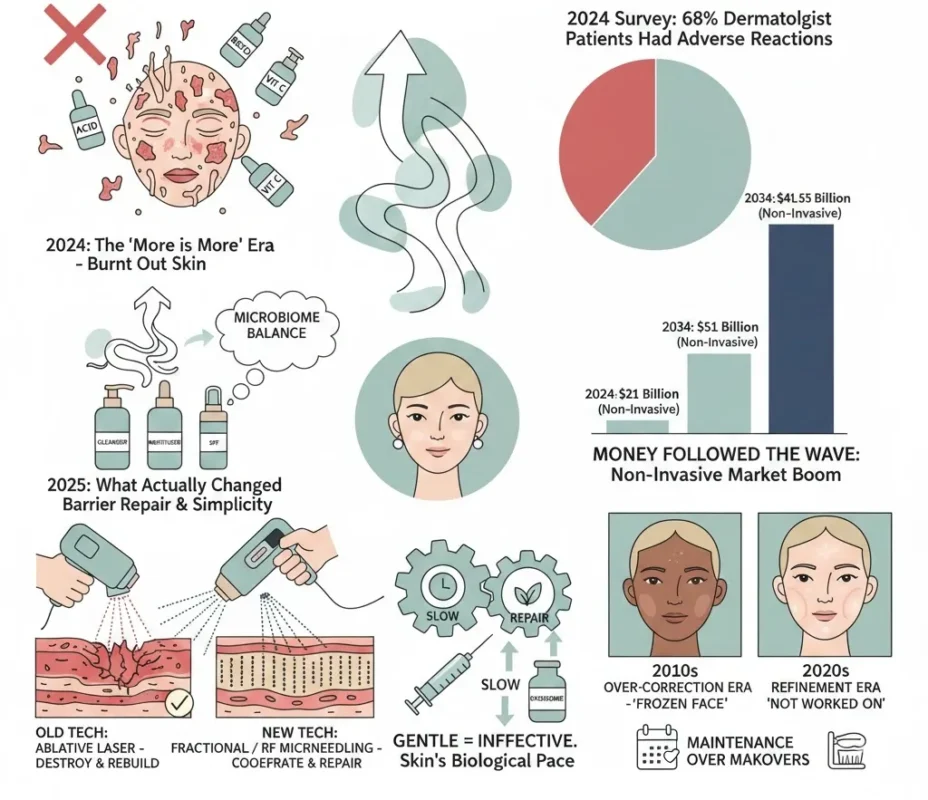
Skincare had a reckoning. In some point, roughly around 2024, a large group of people who had been religiously sandwiching retinoids, acid and vitamin C on their skin every night began showing up at dermatologists’ offices with obliterated skin. Red, inflamed, peeling — the opposite of what all those products were supposed to deliver.
And it wasn’t just a few unlucky people. In for example a 2024 survey from the International Dermal Institute, 68% of Dermatologists had seen patients with reactions that year due to products or routines they’d learnt about on social media. Two-thirds. That is an astounding failure rate for an industry that purported to help people look better.
The whole “more is more” era of skincare broke a lot of faces before it burned itself out.
What Actually Changed
You could see it building if you were paying attention. Ceramide moisturisers started outselling aggressive exfoliating serums. Creators on TikTok — the same platform that popularised 10-step routines — started posting three-product-and-sunscreen videos instead. Dermatologists who’d been quietly saying “you’re overdoing it” for years suddenly had millions of people actually listening.
By 2025, the vocabulary had changed completely. Barrier repair. Microbiome balance. Skin resilience. Words that would’ve gotten you blank stares in a beauty store five years ago became the selling points on product packaging.
The professional treatment world caught the same wave. Practitioners shifted toward procedures that cooperate with skin biology instead of bulldozing through it. And the money followed — the non-invasive aesthetic treatment market sat at roughly $21 billion in 2024 and is on track to reach about $41.55 billion by 2034. That’s not a fad. That’s a structural shift in how people spend on their skin.
What the Procedure Numbers Actually Show
Worth looking at the hard data here because it tells you something the marketing can’t.
The ISAPS 2024 Global Survey the only international scientific study tracking aesthetic procedures performed by plastic surgeons — logged 37.9 million total procedures worldwide in 2024. Of those:
- 20.5 million were non-surgical
- 17.4 million were surgical
Non-surgical options procedures currently outnumber surgical ones worldwide. This gap has been expanding for some time.
The overall medical aesthetics market was $19.54 billion in 2025 and, with a 13% annual growth rate, is expected to reach $40.70 billion by 2031. Most of that growth comes from estrogenic options — injectables, energy-based devices and combination therapies (something like this) that do not require anyone to vanish from their life for two weeks while their face heals.
How the Tech Changed
Older laser systems worked on a pretty blunt principle: destroy the surface, force the skin to rebuild from scratch. It worked, but the recovery was miserable and if you had darker skin, the risk of hyperpigmentation or scarring was high enough that many practitioners simply wouldn’t offer those treatments to a huge portion of the population.
The other approach is almost the negation. Fractional lasers punch tiny columns into the skin while leaving the surrounding tissue untouched. RF microneedling is a way to deliver heat underneath without such severe surface damage, and keep your collagen production game alive. Basically, LED therapy increases cellular energy without even touching.
Semi-moderate non-surgical laser resurfacing fits neatly into this bin – precision targeted, downtime-lite, a little something with which to freshen up one’s skin clarity and texture without ripping them out of their life for weeks on end. It’s a good example of what it is that the technology has done as opposed to where people think it still is.
Why “Less Aggressive” Doesn’t Mean “Less Effective”
This is where a lot of people get tripped up. They hear “gentle renewal” and picture something so mild it barely does anything. But skin rebuilds collagen at its own biological pace no matter how aggressively you treat it. Hammering skin harder doesn’t make it regenerate faster — it just creates more inflammation to recover from.
And overly aggressive treatments can backfire. Too much inflammation (Why does the same pimple keep appearing in the same spot on your face, by the way?) results in prolonged redness and sometimes hyperpigmentation (darker spots) in darker skin tones. ‘‘Treatments that are within the skin’s capacity to repair itself generally produce results that look better and last longer because the skin isn’t using at least 50 percent of its energy just calming down from the treatment,’’ says Zafar.
So this is where regenerative treatments are coming in — PRP, exosomes, biomimetic peptides. They work with the skin’s own repair mechanisms rather than overriding them. And the ISAPS numbers support this: Even in 2024 when total procedure numbers were slightly down overall, continued to remain a top-five nonsurgical treatment worldwide.
Skin Tone and Safety — the Part That Gets Glossed Over
This deserves more attention than it usually gets. A lot of aesthetic technology was developed and tested on lighter skin. Deep chemical peels, ablative lasers, intense pulsed light — these all carry meaningful risks for people with more melanin. Post-inflammatory hyperpigmentation. Scarring. Burns. For years, that essentially shut a huge segment of the population out of professional skin treatments, or at minimum made them a gamble.
Newer devices are built differently. Tunable to person-specific skin tones and sensitivities, such modifiable wavelengths and energies as well as improved cooling are now available for all to customise (the impossible-to-do even five or six years ago). It’s not perfect, and the practitioner is crucial — all other qualities being equal, an experienced practitioner can make a big difference — but the gap between who benefits from these treatments now and who used to benefit has narrowed considerable.
Maintenance Over Makeovers
Here’s the mental switch that is perhaps most profound: People are beginning to approach skin renewal with the same attitude they bring to dental care. You don’t wait to have your teeth falling out before you go to a dentist. You go regularly, catch things early, preserve what you’ve got.
‘Collagen production decreases with age’ As you grow older, your body naturally produces less collagen. That’s just how it works. “A less intense approach to those activities is probably the way to go,” she said, “to maintain some level of elasticity in your skin and prevent deep lines.” Treatments that enable steady collagen turnover and cellular repair fit into a long-term maintenance plan much better than one aggressive intervention every few years once things have already deteriorated. Several dermatologists who spoke with Who What Wear, Vogue Scandinavia and Beauty Independent into late 2025 identified longevity-focused skincare as the number one dermatological theme of 2026.
Gradual upkeep beats dramatic rescue. Most people who’ve tried both will tell you that.
The Overcorrection Era Is Done
Culturally, something shifted alongside the technology. That frozen-forehead, pillow-face aesthetic that was everywhere in the 2010s? Most people don’t want that anymore. What replaced it isn’t “no treatment” — it’s treatment that doesn’t announce itself. Skin that looks healthy, even, rested. Not obviously worked on.
Gentle renewal pairs naturally with this. When you’re not subjecting skin to aggressive procedures, you’re far less likely to end up looking over-treated. The goal walking into a practitioner’s office for most people now is refinement, not transformation. A better version of their own face, not someone else’s.
What Comes Next
The direction is set. Professional skincare is moving toward precision, personalisation, and working with skin biology instead of against it. The market data supports it. The cultural mood supports it. The technology is there and keeps getting better.
The most important thing is that real options exist now. Sun damage, fine lines, uneven texture, or just keeping healthy skin healthy — there are treatments for all of it that don’t demand weeks of downtime or carry outsized risk. That’s a genuine change from where this industry was a decade ago.
Aggressive skincare had its run. The correction was overdue.