

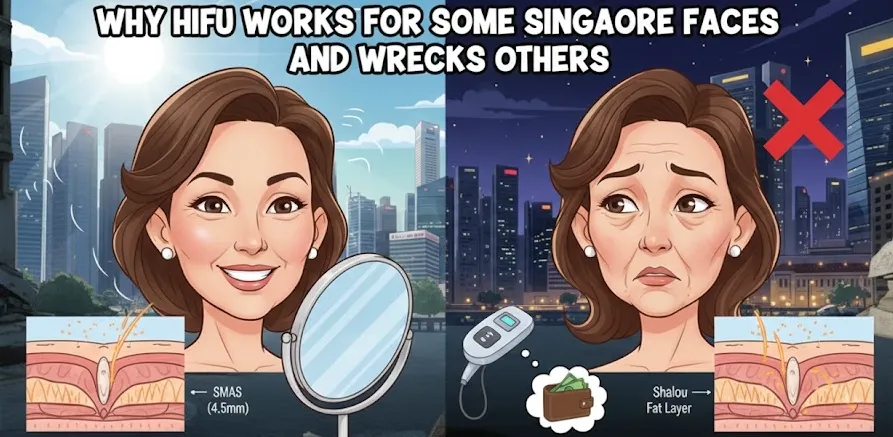
Living in Singapore means your collagen never stood a chance.
The UV index here regularly hits 11 or higher – that’s “extreme” on the World Health Organisation scale. Walk from Raffles Place MRT to your office and you’re already getting hit with radiation that penetrates deep into your dermis, triggering enzymes that chew through your collagen like termites through wood. Add the humidity, the stress, the late nights – your skin’s structural support system is taking a beating from multiple directions.
This explains why so many people here notice their jawline softening in their mid-30s. The face starts looking… tired. Not dramatically older, just somehow less defined than it used to be.
HIFU has become one of the more popular fixes for this. But walk around Orchard and you’ll see it advertised everywhere from medical clinics charging $800+ to beauty salons offering it for under $100. Same technology, supposedly. So what gives?
The Depth That Actually Matters
Most marketing copy talks about “ultrasound energy” and “collagen stimulation” without explaining what makes HIFU different from, say, a nice facial or a radiofrequency treatment.
Here’s what matters: HIFU can reach a layer called the SMAS – the Superficial Muscular Aponeurotic System. This sits about 4.5mm beneath your skin’s surface. The SMAS is essentially a fibrous network that connects your facial muscles to your skin. It’s the same layer plastic surgeons manipulate during a surgical facelift.
When HIFU delivers focused ultrasound energy to this depth, it heats tissue to between 60°C and 70°C, creating what’s called thermal coagulation points (Quantified Facial Rejuvenation, Plastic and Reconstructive Surgery – Global Open, 2022). That controlled injury triggers two responses: immediate tissue contraction, and then over the following months, new collagen formation as your body repairs the area.
The 4.5mm transducer is the one doing the heavy lifting for actual facial lift. Shallower depths (1.5mm, 3mm) work on different skin layers – good for texture, but not where structural lifting happens.
Why That $99 Salon Deal Might Be Pointless
Not all HIFU devices are built the same.
Medical-grade machines like Ultherapy or Ultraformer III are cleared for use at energy levels that can genuinely reach the SMAS and generate sufficient heat for tissue coagulation. The cheaper machines often found in beauty salons? Many lack the power output to hit these depths effectively, or they’re operated at lower settings to minimize discomfort.
Lower energy means less heat. Less heat means no thermal coagulation points. No coagulation points means no collagen remodeling. You get a warm face and lighter wallet.
A 2020 meta-analysis looking at 17 HIFU studies found that the procedure produced moderate improvement scores – but these were from medical-grade devices in clinical settings (Lasers in Medical Science). The budget versions haven’t been through this kind of scrutiny.
The Fat Loss Problem Nobody Warns You About
Here’s something that should be part of every HIFU consultation but often isn’t: HIFU can destroy fat cells.
Research published in Biomolecules (2023) documented that HIFU decreases subcutaneous fat tissue through apoptosis – programmed cell death. For body contouring around the stomach or thighs, that’s the entire point. For facial treatments, this becomes a serious concern for certain patients.
If you already have a slim face, hollow cheeks, or minimal facial fat, aggressive HIFU treatment can make you look gaunt. The cheeks sink. The temples hollow out. Instead of looking refreshed, you end up looking tired or even older than before.
Plastic surgeons have reported seeing patients who needed fat grafting to restore volume lost after poorly administered hifu face lifting treatment Singapore sessions. The risk increases when:
- Incorrect depth cartridges are selected for your face type
- Energy levels are set too high
- Treatment is done too frequently
- The practitioner doesn’t assess your facial fat distribution beforehand
If you have naturally full cheeks you’re happy with, this needs to be discussed before anyone fires up the machine.
What It Actually Feels Like
HIFU isn’t painless. Anyone telling you otherwise is either using weak equipment or lying.
That meta-analysis I mentioned earlier? It found the mean pain score during treatment was 4.2 out of 10 across studies. Some areas hurt more than others – the jawbone and areas near the hairline tend to be worse because there’s less tissue between the transducer and bone.
People describe it as brief pulses of heat or sharp prickling sensations. Each pulse lasts a fraction of a second, but over a 30-60 minute session, those fractions add up. Most people tolerate it fine without numbing cream. Some clinics offer it anyway.
The discomfort ends when the treatment ends. You might have some redness or mild swelling afterward, but most people return to normal activities the same day.
The Waiting Game
Expect nothing dramatic for at least 4 weeks. Possibly longer.
Initial tissue contraction happens during treatment, but the real results come from collagen remodeling – and that’s a biological process that doesn’t care about your impatience. A study in Annals of Dermatology (2015) found that clinical improvement was significant at 3 months post-treatment and maintained through 6 months.
This is actually an advantage for people who want subtle changes. Your face gradually firms up over months. Nobody wakes up looking obviously “done.” The shift happens slowly enough that people around you might just think you look well-rested.
Who Should Skip It
HIFU isn’t the answer for everyone. Consider other options if:
- You have severe skin laxity – the kind where there’s significant excess skin hanging. HIFU stimulates collagen, but it can’t remove tissue. Thread lifts or surgical intervention might be more appropriate.
- You’re very lean-faced – as discussed, fat loss is a real risk. If you don’t have volume to spare, aggressive HIFU could hollow you out.
- You expect surgical results – HIFU provides measurable improvement, but it’s not going to replicate what a facelift does. Systematic reviews show improvements in skin laxity ranging from 18% to 30% (Aesthetic Surgery Journal, 2025). Real improvement, but still within a range that some might find underwhelming depending on expectations.
- You’ve had certain recent procedures – Botox, fillers, thread lifts within the past 4-6 weeks need to be disclosed. The ultrasound energy can interact with these.
Making a Decision
If mild-to-moderate skin laxity is bothering you and you want something that doesn’t involve surgery, needles, or significant downtime, HIFU sits in a useful middle ground.
The effectiveness is backed by decent research when medical-grade devices are used properly. The risks are manageable when the operator actually understands facial anatomy and adjusts the treatment to your specific face.
Where it goes wrong: bargain hunting, inexperienced operators, cookie-cutter protocols applied regardless of individual facial structure, and unrealistic expectations on both sides.
A proper consultation should include assessment of your skin thickness, facial fat distribution, treatment goals, and honest conversation about what’s achievable. If someone promises you’ll look 10 years younger, find someone else.